
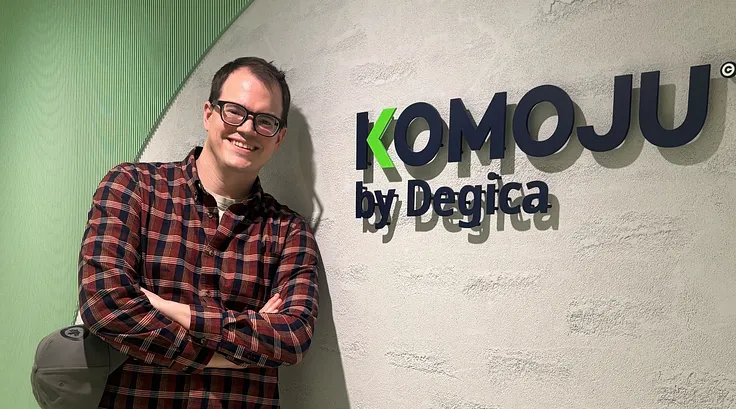
”The original question you had asked,” said Richard Ramsden, CTO at Degica, “was, ‘How do people make a life for themselves here, and start their career right, and not have a bad experience when they come to Japan?’ It doesn’t work out for everyone.”
There are some people that come to Japan, and [their experience] only lasts maybe like a year or two, and then they’re out. . . . I think a big factor is the company that you’re working for.
Ramsden also wasn’t initially having a great experience in Japan, until he found the right company for him. “Eventually I found a really good employer that was a great culture fit, and just ended up being successful here. My career has been good. And my life’s been great because of my career, and the people that I met along the way.”
In this article Ramsden explains his path from Ruby developer to CTO, as well as:
- How job-hunting has changed for international developers
- What didn’t work for him career-wise in Japan
- Why you need a company you can grow with
- The difference between being a “great fit” and “fitting in”
- How not speaking much Japanese can affect your career and your life
- Why Japan is a great place for international developers
- How to pick the right company for you
His scavenger hunt
Ramsden was a junior developer when he first arrived in Japan. ”I was maybe a year and a half out of university. When I was young I thought I was a big hot shot,” he joked, “but looking back, I was super junior.”
Despite feeling confident, Ramsden took a slow, prudent approach to starting his career in Japan. His first trip to Tokyo was for a Ruby Kaigi conference, where he also worked to make connections with local companies and people. He’d assumed he would need to speak Japanese fluently to get a job, and was pleasantly surprised to find that wasn’t the case.
Soon after he applied for a working holiday visa, which he’s eligible for as a Canadian citizen.
I think [because of] TokyoDev and lots of job boards, it’s much easier to find a job here if you’re a foreign candidate. Back 13-something years ago, I had to literally go on a scavenger hunt. I had to come on a working holiday [visa] because I had no idea. I just had a dream.
“I think my original interview I found through an internet chat room,” he told me. “Someone was like, ‘Oh boy, I wish we had a Ruby developer.’ And I’m like, ‘Oh, hey, I’m a Ruby developer.’”
Since he was already in Japan, it was much easier for the company to hire him. “I could actually go down to the office and talk with them face-to-face. I think that does help improve [your] odds when you’re actually here and they don’t have to go through all the visa paperwork.”
What didn’t work
Ramsden’s focus on moving to Japan, though, came with a downside: he was so keen to find work with a Japanese company, that he didn’t carefully evaluate which Japanese company would be best.
“ I had to go through a few companies before I found the right culture fit,” he said. “I joined a Japanese company for my first job. However, with the working style of domestic companies here, I felt pressure to work late rather than having the focus be on my output. I stayed there a few months and left to try and start a business.”
Ramsden and his friend collaborated on the attempted startup, but it proved incompatible with remaining in Japan. “Back 13 years ago when I first came here, there was no support for startups at all,” Ramsden said, “and me and my friend just weren’t able to get visas.”
Eventually his friend had to leave the country, and Ramsden accepted another job in order to remain in Japan—one that, again, wasn’t a good culture match.
Finding a company to grow with
Soon after that, however, he joined Degica, where he has remained for 11 years. “I’m now the CTO. And I think the biggest reason [I stayed] was because I met the people and I was more picky about the company I was joining. I wanted to make sure that I was going to be a [good] fit at the company.”
Since I’ve been such a great fit, I’ve been able to grow with the company as I get more domain knowledge, and understand more about the internals of the company and how it works. Eventually, that leads to promotions.
Being a good fit by standing out
Degica has been a good fit for Ramsden because it’s allowed him, and even encouraged him, to lean into his differences.
“Weirdly, I think [being non-Japanese] has been a positive for my career,” he explained, “because it allows me to work a little bit out of the typical Japanese cultural rule set. So I am in the office now in my flip flops and shorts.”
“If you really want to assimilate,” he added, “you get into following all of the cultural norms. And I think some of these norms slow things down—you’re usually being too formal when you want to be candid about something.”
So I think in my career it’s been good, because a lot of the challenges that we have when we really need to grow are from some groups in the company being too risk averse or conservative. And I can come in from the foreign mindset and [say] like, ‘Hey, let’s just do it. Let’s try this, guys.’
“And then [they said] ‘Okay, let’s let the foreigner try to build his payment system thing.’ And I did that, right?” said Ramsden, referring to Degica’s KOMOJU payment platform, which he played an instrumental role in developing. “I threw it out there. And now we’re a successful business . . . because I took a risk. I was comfortable taking a risk.”
Are Japanese skills necessary?
Ramsden self-describes his Japanese ability as “terrible,” but doesn’t believe it’s held him back professionally. “I’ve been working in completely English-speaking environments. At the company, our product engineering is 100 percent English, and it’s been that way since I joined 11 years ago.”
In Japan, weirdly, there’s enough international business that you can grow a career here in just English, which is wild.
Ramsden does sometimes wish he had more Japanese-speaking friends. “I think if I would’ve maybe joined a pure Japanese environment [company], I could have had opportunities to grow some of those friendships and maybe get out of my comfort zone a little bit.”
On the whole, however, he’s satisfied with his social life, which revolves around other international workers. “We have the same experiences. We’re foreigners living in Japan. And I think it’s more relatable to talk to another foreigner that’s living here.”
Not speaking Japanese well can be a stressor in daily life, though. “Unfortunately, for me,” Ramsden joked, “it’s [now] easier to just get by with English in Tokyo. There’s just so much support here because they’ve been dealing with [an] influx of tourism and more foreigners.”
When I came, I was going down to the city office [and it was] all in kanji. Maybe that’s still the case today, but there was no one there to support me. Now, and maybe in my local city office, there’s a foreigner working in the office that comes by and helps me do the paperwork in English.
Why is Japan good for developers?
“The food’s great and it’s safe here,” said Ramsden. “It’s got anime and video games. That was one of my reasons [for coming here] originally. . . . Those are not so important to me at my point in life. But that played a factor in me coming to Japan in the first place.”
Anime may have brought him here, but Ramsden has remained in Japan for some very practical career reasons. “If I’d stayed in Canada, I’d be starting on the same playing field as almost the entire population,” he said.
When you come to Japan, you’re bringing some unique skillset into the country that makes you valuable, right? There is a reason they are importing engineering talent here. They don’t have enough engineering talent. In Canada, in the US, I think you have a lot of talent there, so it’s much more competitive.
Ramsden noted that not only is there an increasing number of international developers in Japan, there’s also more support for them. “ [The industry is] way more open to recruiting foreign talent. The government is trying [too], I know they have more lenient startup visas.”
Does this mean Ramsden intends to remain in Japan for the remainder of his career? “ That’s a good question,” he told me. “And I’ve also talked closely with my spouse, like, ‘What’s next?’”
Primarily, he’d be interested in returning to his home country for two reasons: to start a business, or to raise children. “I’ve been through lots of companies, lots of startups, and I’ve always been working for other people.”
I think if I had my own vision or my own idea, that would be a strong incentive to go set up shop somewhere in Canada and recruit in North America and build a business there.
So would expanding his family. “I don’t have kids yet. Definitely, that would be a big motivation for me to move back, maybe to Canada, or to look at the [Japanese] countryside, because if I had children, I’d probably want to give them the same type of upbringing that I had.”
“But I still have a deep love for Japan,” he clarified. “As part of my career, I’ve gotten the opportunity to travel almost everywhere in the world. . . . I have perspective now, and I see the two best places that I would love to live are either in Canada, where I was born, or Japan.”
My career has been going so well. I think that’s been a big reason why I’m still here. . . . And that goes back to your career development, like who you pick for your company. Make sure the company can grow with you.
How to pick the right company
Talk to insiders
Finding the right company for you can be easier said than done. “Sometimes that is difficult if you don’t have a lot of experience yet,” Ramsden acknowledged. “You don’t really know what your fit is.”
One way to screen out bad fits, though, is to speak with the employees at any company you interview with.
Talk to some developers or talk to some people who are on the ground working. Be a little bit wary [when] you’re on a call, but it’s all leadership. They’re putting on a story and they’re literally sales people.
Ramsden made it clear he spoke from experience. “I applied for a company where I didn’t talk to the people on the ground, and guess what, it wasn’t a fit. But during the interview process, everything was like a sales pitch. It sounded super exciting. . . .Then I got in and the developers were like, ‘Oh, man.’”
Take your time
This is partially why Ramsden recommends not rushing to secure a role. “ I think a mistake people make early on in their career,” Ramsden said, “is they take the highest-paid offer. They don’t know that culture plays such an important part of just having happiness in your career.”
If you’re not vibing with the people that you’re talking to, if you’re feeling weird about the interview process, you should follow that vibe. Stop the process and keep looking for a company where you’re going to be a really good culture fit.
Be open to startups
Depending on where you are in your career, the right place could be a startup. “If you’re young, I think you can take on a lot more risk, right? And actually a startup might also be a really good place, even though it might appear a bit crazy and unstable. I do think it builds a good foundation to then go and find your next job.
“It’s a unique experience that you don’t get as you get older. You don’t get that chance to join a chaotic, fast-growing company. . . . And I think those are interesting opportunities to at least bring you in and get your visa.
“Then, once you’re situated, start looking. If that place is not a good culture fit for you, start looking for a really good place where the culture fit is there. Even if that’s a bigger company or like a mid-size or larger entity, that’s going to do wonders for being able to keep your career here.”
Avoid job-hopping
That being said, Ramsden is not an advocate of changing roles every few years. “I work at a company where we hire everyone from all over the world, and I think [some employees] do have a bit of that North American culture, where it’s [job] hop and try to get the best offer. When you try to do it here, it’s frowned upon by the employer. It’s a different value system.
“I don’t want to push that you should just settle for whatever,” Ramsden stressed. “But this is just how I’ve been able to grow.”
It’s also the reality of succeeding long-term in Japan. “I think if you’re able to grow with the company, then you can keep moving up. I don’t want to say it’s just based on seniority. . . . [But] I do think some seniority is needed, because if you join a company, how much are you really going to accomplish in just one year?
“Maybe after one year you have some of the domain knowledge and some of the things that you need to actually start making an impact, right? And then you usually see [in] year two and year three, you’re making a big impact. [So] you don’t want to be hopping, right? Where you just get all the knowledge, and then you leave.”
Nonetheless, as Ramsden reiterated throughout the interview, what matters most is that you like where you work.
> At the end of the day, if you don’t like where you’re working, you’re not going to last very long here. I think one thing people say about Japan is that it can be a great place as long as you have a good work environment.
